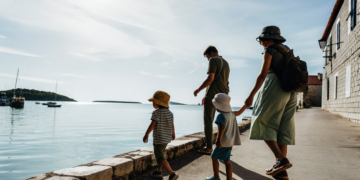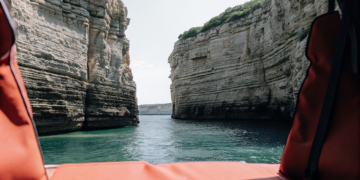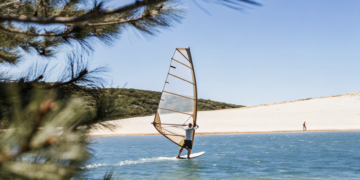













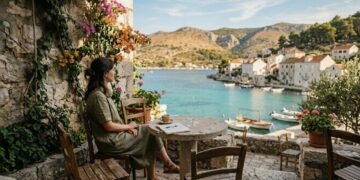


Yes, it’s safe to swim in Croatia, genuinely, reassuringly safe. The Adriatic is clean, calm and close to tideless, there’s no meaningful shark risk, and millions of people swim here every summer without incident. If you came looking for a reason to worry, the honest answer is that there mostly isn’t one. What’s actually worth knowing fits on a postcard: wear water shoes on rocky entries so you don’t tread on a sea urchin, give the odd jellyfish a wide berth, respect one small fish called the weever, don’t swim out too far on a windy day, and apply the same sun-and-alcohol common sense you’d use at any beach. Do that and the sea is one of the best things about the country.
Below is the real version of each: what the risk actually is and what to do if you meet it. Save 112 in your phone before you read on; it’s the only number you need, and the operators speak English.
Is it safe to swim in Croatia?
Very. The Croatian Adriatic is among the cleaner stretches of sea in Europe, and its water quality is measured and published every year. In the European Environment Agency’s 2025 bathing-season assessment, about 86% of Croatia’s bathing waters rated “excellent”, down from over 95% the year before, which made local headlines, but still comfortably clean, with almost every monitored site meeting at least the minimum EU standard (checked August 2026). “Is the water dirty?” is not a question you need to lose sleep over.
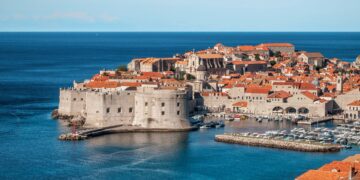
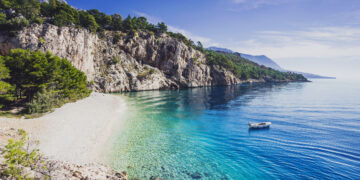
The Adriatic also behaves itself. There’s very little tide, currents near shore are usually weak, and most swimming happens in sheltered bays and coves rather than open surf, a big part of why Croatia feels so easy to swim in compared with an ocean coastline. The clearest, most crystal-clear water is generally off the islands: around Hvar, Vis, the Kornati archipelago and the Elaphiti near Dubrovnik. Wherever you go, the hazards that exist are small, local and avoidable, not the sea itself.
Are there sharks in Croatia?
There are sharks in the Adriatic, and there is effectively no danger to you from them. Both mako and great white sharks pass through Croatian waters, which sounds alarming until you look at the numbers: across the entire Adriatic, roughly a dozen fatal shark encounters have been recorded in the last 150 years, the most recent in Croatia in 1974 (checked August 2026). A single non-fatal bite in 2008 is the only incident anyone can point to this century. Against the tens of millions of people who have swum here since, the risk rounds to zero — you’re far more likely to come to grief driving to the beach than swimming at it.
Sharks that could theoretically harm a person stay in deep water far from the pebble coves where tourists swim, and encounters with swimmers are essentially unheard of. What you will see, if you’re lucky, is a dolphin, common in the Adriatic and entirely harmless.
Wear water shoes: sea urchins and rocky entries
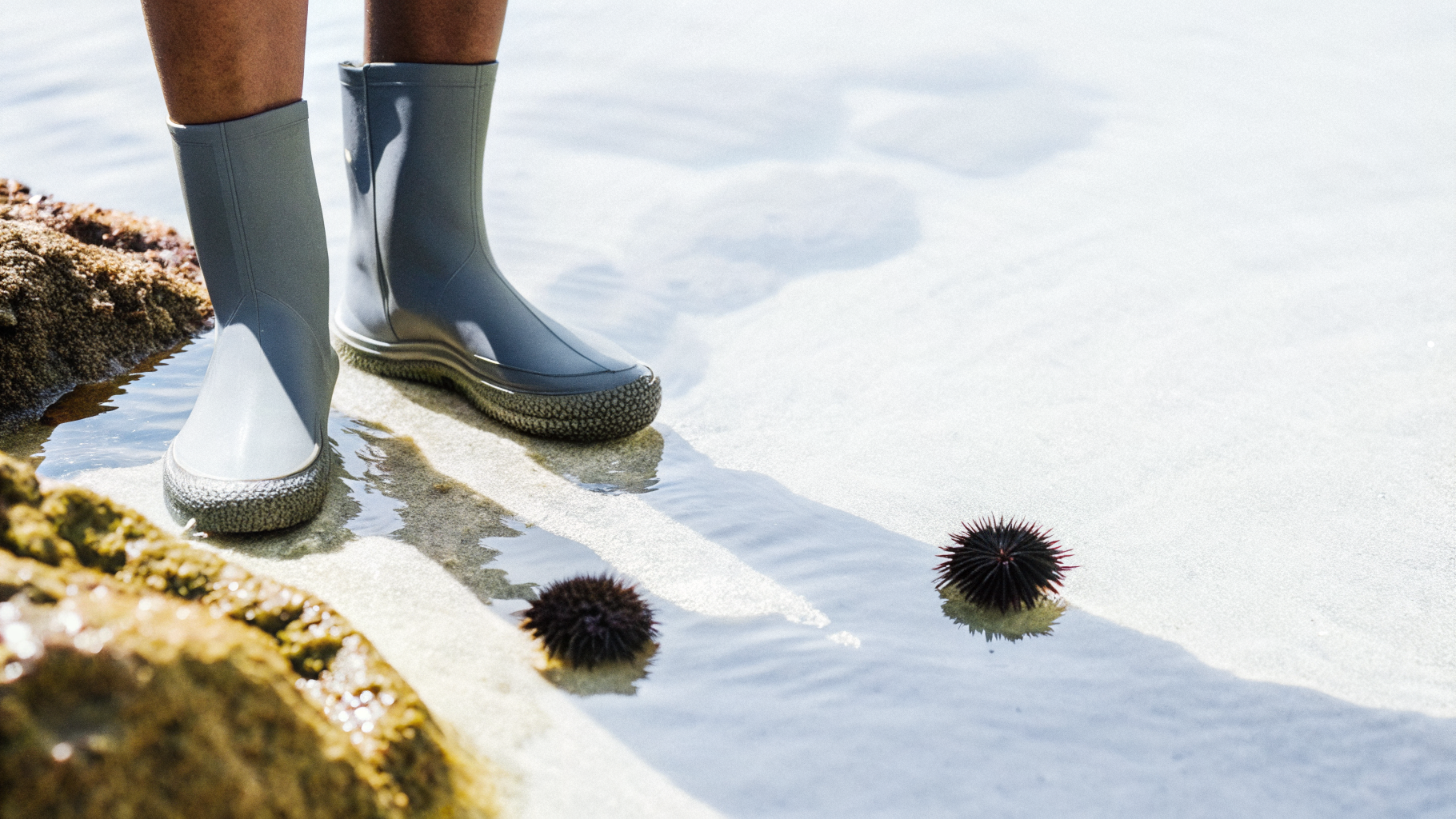
If Croatia has a signature swimming injury, it’s the sea urchin. Most Croatian beaches are pebble or rock rather than sand, and the rocky shallows and ladders where you get in and out are exactly where black sea urchins cling. Step on one barefoot and you’ll drive several brittle spines into your foot, painful, and annoying to remove.
The fix is almost too simple: wear water shoes. A cheap pair of rubber-soled swim shoes solves urchins, hot stones and slippery limestone in one go, and they’re the single most useful thing you can pack for a Croatian beach holiday. Locals and seasoned regulars wear them without a second thought.
If you do get spined, get out and remove the visible spines with tweezers or the edge of a bank card, the same way you’d handle a splinter; soaking the foot in water as hot as you can comfortably stand eases the pain. Spines snapped off deep, or a foot that later swells or won’t stop hurting, are worth a trip to a pharmacy (ljekarna). They’re widespread and used to this exact complaint. For more on rocky-beach specifics (hot stones, ladders, valuables), see our guide to beach safety in Croatia.
The weever fish: Croatia’s one genuinely nasty sting
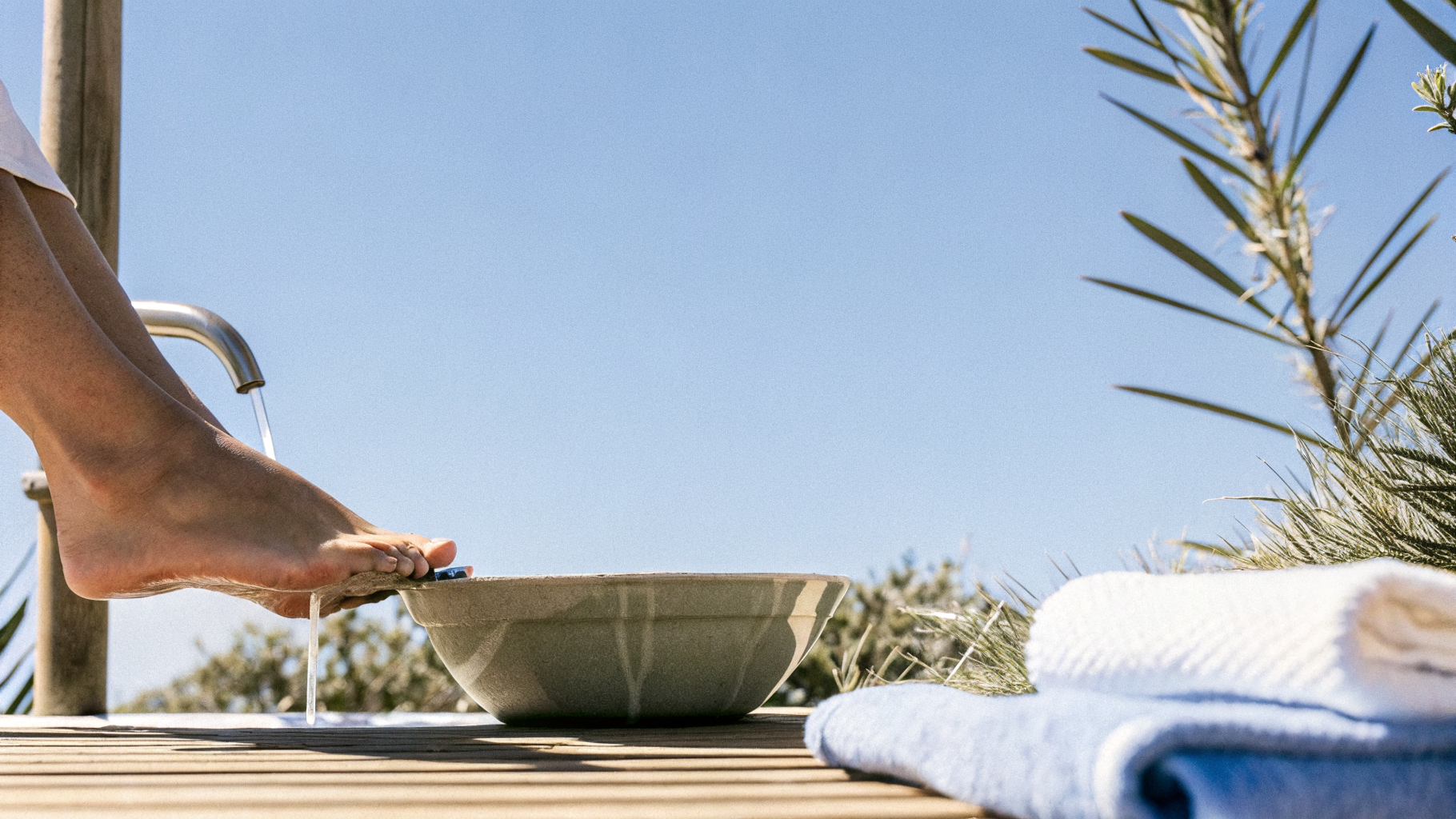
If there’s a single marine creature worth taking seriously in Croatia, it’s the weever fish (Trachinus), and almost nobody warns you about it. Weevers are small, sandy-coloured fish that bury themselves in shallow sandy bottoms with only their venomous dorsal spines showing, so you meet one by standing on it, especially around dusk. The sting is memorably painful, far worse than an urchin, and it’s the one first-aid situation here where knowing the trick really matters.
The venom is a protein that breaks down with heat, so the treatment is heat. Get out of the water, rinse the wound with seawater (not fresh water), remove any visible spine fragments with tweezers or a card edge, then immerse the area in water as hot as you can tolerate (without scalding yourself) for at least 30 minutes, topping up the heat as the pain allows. Paracetamol or ibuprofen help too. This hot-water immersion is the standard first-aid advice from the UK’s NHS for weever and sea-creature stings (checked August 2026). Seek medical help if the pain is unbearable, the spine is stuck, the sting is to the face, or you feel unwell. Serious cases are rare; the heat usually turns an agonising sting into a manageable ache within the hour.
Jellyfish in Croatia: season, sting care, and the vinegar myth
Jellyfish come and go with the season and the wind. Most years they’re a non-event; in warm years there are more of them, and 2026 has seen above-average sightings, mostly harmless moon jellyfish and the painful-but-not-dangerous compass jellyfish around Istria, in line with a steadily warming Adriatic (checked August 2026). The great majority you might meet are harmless or merely irritating. The one to respect is the mauve stinger, Pelagia noctiluca: small, purplish, and capable of a burning sting. None of these is an emergency for a healthy adult, but it’s worth knowing how to handle a sting, and, just as important, what not to do.
If you’re stung, here’s the current, evidence-based version:
- Rinse with seawater, not fresh water. Fresh water (and rubbing) can make undischarged stinging cells fire and worsen it. Pluck off clinging tentacle bits with the edge of a card, not bare fingers.
- Skip the folklore. Do not pee on a jellyfish sting, and do not pour vinegar on a Pelagia sting. The vinegar tip you’ve heard is real advice for certain tropical box jellyfish; on the Mediterranean mauve stinger the Med-Jellyrisk consortium specifically advises against it (checked August 2026).
- Ease the pain. Take a painkiller; a pharmacy can supply a soothing gel. Watch for any whole-body reaction (spreading rash, difficulty breathing, dizziness), rare, but a reason to call 112 at once.
For most people a jellyfish sting is a sharp welt that fades over a day or two. If you’re snorkelling in a jellyfish-heavy spell, a rash guard is quiet insurance: more on that in our snorkelling safety guide.
Currents, wind and swimming out too far
The real open-water hazard in Croatia isn’t a creature — it’s wind. A still morning sea can chop up by afternoon as the maestral breeze picks up, and the fierce bura can arrive off the mountains with little warning. Wind pushes anything floating away from shore. Every season, people on inflatables, air mattresses and paddleboards get blown out to sea faster than they can paddle back. The flotation that felt safe is exactly what turns you into a sail.
So: check the forecast and the flags before you swim, and don’t trust an inflatable in any breeze. For open-water swimming between islands or across a bay, don’t go alone, keep close to shore or a boat, and remember that boat traffic (day-trip boats, tenders, jet-skis) is a real risk in busy channels where a low swimmer is hard to spot; a brightly coloured tow float makes you visible. If you’re caught out and can’t make progress against the wind, stay with your board or float, signal, and call the national sea rescue on 195 or 112. Our kayaking and SUP safety guide goes deeper on reading the wind.
The risks people forget: sun, alcohol and shallow dives
The hazards that actually put people in Croatian hospitals in summer are the boring ones. The midday sun on the coast is stronger than most visitors expect: swim in the morning or late afternoon, and drink more water than you think you need. Alcohol and swimming don’t mix. A boozy lunch followed by a swim off the rocks is a genuinely bad idea, and a factor in a real share of drownings every year. Save the swim for before the wine, not after.
One more, because it causes the worst injuries of all: never dive headfirst into water you haven’t checked. Croatian bays are clear but often shallower and rockier than they look, and every summer someone breaks their neck on a dive that looked fine from the ladder. Get in feet-first until you know the depth. If you’re travelling with children, remember most beaches have no lifeguard: keep small kids in arm’s reach in the water, put them in water shoes too, and don’t treat inflatable armbands as supervision. Our family-travel safety guide covers kid-specific first aid and beach logistics in more detail.
Lifeguards, flags and Blue Flag beaches
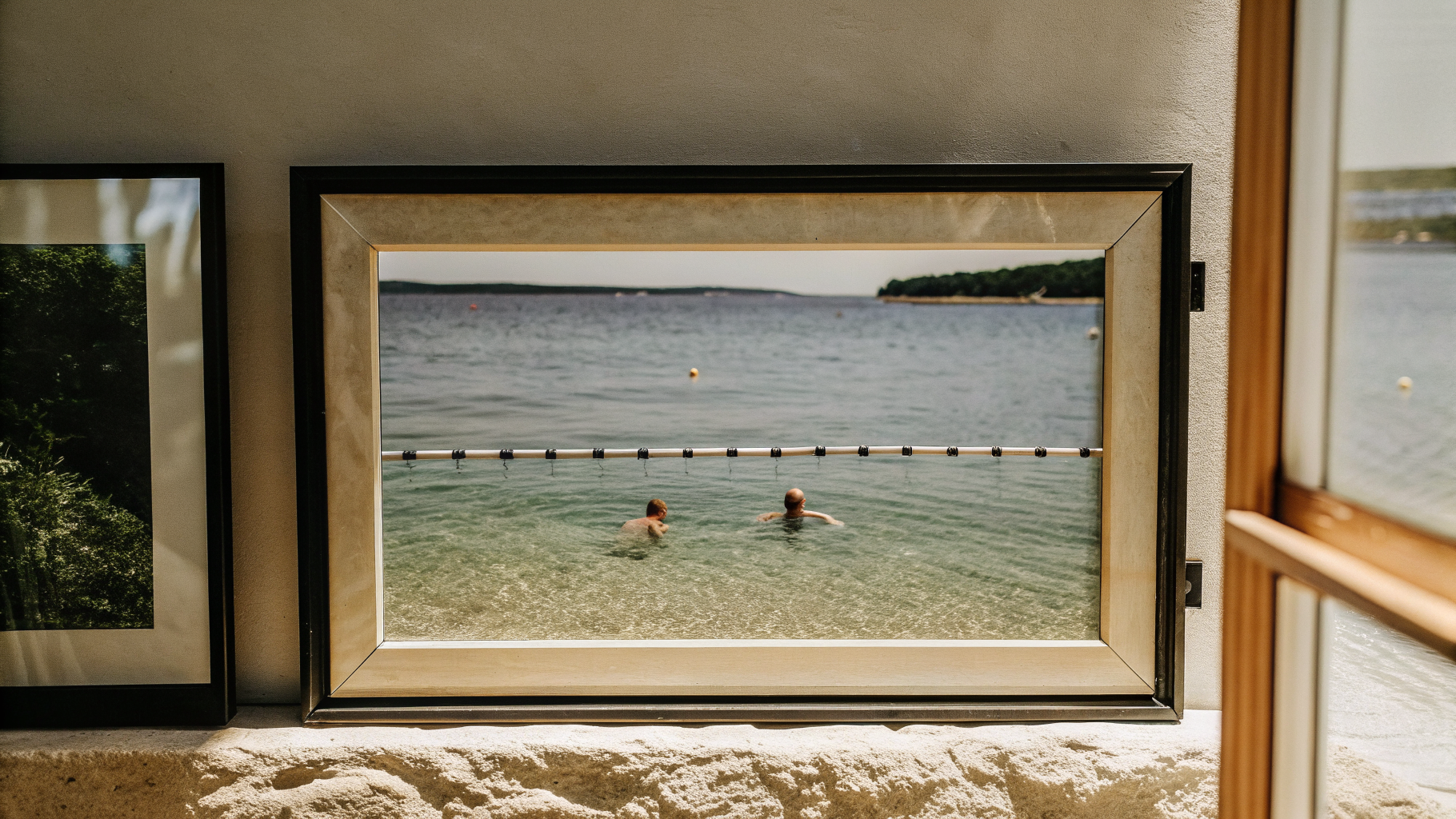
An expectation to reset before you arrive: most Croatian beaches are not lifeguarded. Croatia doesn’t have the pervasive lifeguard culture of an American or Australian coast. A minority of beaches (often resort, town or Blue Flag beaches) do post a lifeguard and keep first-aid on hand in July and August, and those tend to fly the familiar warning flags. But the default assumption should be that you’re responsible for your own safety in the water, and you should swim within your ability accordingly.
The Blue Flag is a useful shortcut: an international award given to beaches and marinas that meet standards for water quality, safety, facilities and environmental management, and Croatia has well over a hundred along the coast. It doesn’t guarantee a lifeguard, but it’s a reliable sign of clean water and an actively managed beach. Where a beach marks off a designated swimming area with buoys, stay inside it. Those lines keep swimmers and boats apart for exactly the reason above.
Can you swim in Croatia’s rivers, lakes and national parks?
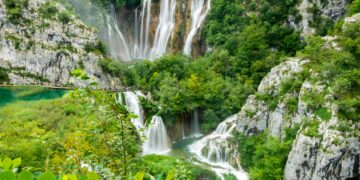
Some of Croatia’s most photographed water is freshwater, and the swimming rules there are stricter than at the coast, for good reason. At Plitvice Lakes National Park, swimming is banned outright: the lakes are a fragile travertine system with no barriers, deep drop-offs and slippery boardwalks, and the ban is strictly enforced. Treat it as look-don’t-touch.
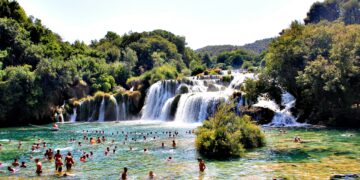
Krka National Park is the famous exception, but the rules have tightened and swimming is now limited to designated spots rather than the free-for-all it once was. Before planning a waterfall swim, read our dedicated guide to swimming in Krka National Park for where it’s currently allowed and what’s changed; for the parks more broadly, see our national-parks safety guide. Wherever you swim in fresh water, the same sense applies: know the depth, don’t jump into unknown pools, and mind that river and lake water is colder than the sea.
When is the best time to swim?
The Adriatic warms into the mid-20s Celsius by July and August, and it stays pleasantly swimmable from June into October. The sea holds its warmth well into autumn. May and early June are cooler and much quieter. Whenever you go, the safety picture is the same; the only seasonal variables worth checking are this year’s jellyfish situation and the daily wind, both of which local beach chatter and the forecast will tell you.
Which guided swims are safest?
For most swimming (off a beach or cove near your accommodation) you need no guide; you just walk in. Where a guided option earns its place is open-water and island swimming, where a boat gives you a safety platform, a driver watching the water, and someone who knows which coves are sheltered and which channels are busy.
If that appeals, the full-day Elaphite Islands cruise from Dubrovnik is a long-running, heavily reviewed trip (around 4.9 stars from over 10,000 reviews) with swimming stops at quiet island coves, a relaxed way to get into clear water away from the crowds, and a good option if solo open-water swimming makes you nervous.
Frequently asked questions
Is it safe to swim in Croatia?
Yes, very. The sea is clean, calm and close to tideless, with no real shark danger. The only hazards worth knowing are minor and avoidable: sea urchins on rocky bottoms (wear water shoes), the occasional jellyfish, the rare weever fish, and windy days that push floaters offshore.
Are there dangerous sharks or jellyfish in Croatia?
Dangerous sharks exist in the Adriatic but attacks are extraordinarily rare. The last fatal one in Croatia was in 1974. Jellyfish are more common; most are harmless, and even the stinging mauve stinger (Pelagia noctiluca) is painful rather than dangerous for a healthy adult.
What should I do if I step on a sea urchin or get stung?
For an urchin, remove the visible spines with tweezers or a card edge and soak the foot in hot water; see a pharmacy if spines are deep. For a weever-fish sting, immerse the area in very hot water for at least 30 minutes. For a jellyfish sting, rinse with seawater, remove tentacle bits with a card, and skip the vinegar and the urine. Neither helps.
Are there lifeguards on Croatian beaches?
Usually not. Most beaches are unlifeguarded; some resort, town and Blue Flag beaches post one in July and August. Assume you’re responsible for your own safety and swim within your ability.
Can I swim in Croatia’s national parks?
Not at Plitvice, where swimming is banned. Krka allows it only in designated spots, and the rules have tightened. Check before you go. The warmest sea for coastal swimming runs July–August, and it’s comfortable from about June to October.
The short version
Swimming in Croatia is about as safe as sea swimming gets. Pack water shoes for the rocks and urchins, respect the weever fish’s hot-water fix, treat jellyfish stings with seawater rather than folklore, and don’t let wind or an inflatable carry you out to sea. Skip the midday sun and the post-lunch drink, check the depth before you dive, and watch the kids. Most beaches have no lifeguard. Do that, and the clear Adriatic is exactly the worry-free pleasure it looks like.
The practical bit
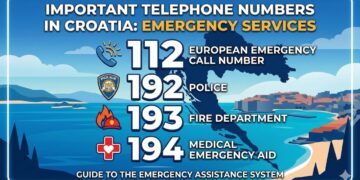
Emergency numbers. 112 is the single European emergency number (police, fire, ambulance, plus mountain and sea-rescue dispatch), with English-speaking operators, the one to save. 195 is national sea search & rescue (MRCC Rijeka); note it alongside 112 if you’ll be swimming or paddling in open water or off a boat. Behind 112 sit the direct lines (192 police, 193 fire, 194 ambulance), but 112 reaches them all. (Emergency numbers checked August 2026.)
What to pack: water shoes (the single best buy), a small tow float or brightly coloured cap for open-water swims, reef-safe sunscreen, and a basic first-aid kit with tweezers and painkillers.
Travel insurance: make sure your policy covers swimming and any water activities you’ll actually do. Some exclude “extreme” or unlicensed activities, and the EU’s EHIC/GHIC card is useless to US travellers, who need private cover.
General guidance only, not medical or legal advice. Conditions, wildlife and park rules change; check locally, watch the flags, and follow lifeguards’ and operators’ instructions.