



















Vipers and Venomous Snakes in Croatia: How to Stay Safe on Croatian Trails
The Nose-Horned Viper, Snake Bites, and What to Do If You’re Bitten — a Hiker’s Guide to Dangerous Animals in Croatia
Croatia is one of Europe’s finest hiking destinations — from the karst peaks of Velebit to the forests of Gorski Kotar and the sun-bleached trails of Dalmatia. It also happens to be one of the areas in Europe where venomous vipers are most widespread. That combination makes snake safety a genuinely useful topic for anyone planning time outdoors in Croatia — not because snakes are a serious danger to hikers who know what they’re doing, but because knowing what you’re dealing with makes all the difference between a calm encounter and a preventable emergency.
The short version: Croatia has 15 species of snakes, of which only three are venomous. Fatal snakebites are extremely rare — the Croatian Institute of Public Health records just three snakebite deaths in the last twenty years. With the right footwear, a little awareness, and clear knowledge of what to do if you’ve been bitten, you can hike Croatian trails confidently and safely.
Venomous Snakes in Croatia: The Three Dangerous Animals to Know
Croatia’s snake fauna belongs almost entirely to the family Viperidae — the only venomous snake family found in Europe. Of Croatia’s 15 species of snakes, three are venomous snake species capable of causing serious harm, while the remaining species are non-venomous and harmless to humans. Two additional semi-venomous species exist (the Montpellier snake and the European cat snake) but cannot bite humans hard enough to inject venom.
1. The Nose-Horned Viper (Vipera ammodytes) — Poskok
The nose-horned viper — known in Croatia as poskok, meaning ‘jumper’ — is the most important venomous snake in Croatia and the most dangerous European viper. Vipera ammodytes ammodytes is the predominant subspecies, particularly common in Dalmatia, where it inhabits dry, rocky hillsides, stone walls, and scrubby Mediterranean vegetation. It grows to an average length of 85cm, occasionally reaching one metre, with fangs up to 13mm long.
Identification is straightforward: the poskok has a distinctive soft horn on the tip of its nose — unique among Croatian snakes — a triangular head clearly separated from the body, and a dark zigzag line running the length of its back. Colouring varies from ash-grey to yellowish-brown and reddish-brown; black and white specimens also exist. The Vipera ammodytes ammodytes subspecies is mostly active at night, which is useful to know — most daytime hiking encounters involve a snake that would rather flee than fight.
Scientific classification: Family Viperidae, genus Vipera, species Vipera ammodytes. The subspecies found across Dalmatia and most of Croatia is Vipera ammodytes ammodytes.
2. The Common European Viper (Vipera berus) — Riđovka
The common European viper — riđovka in Croatian — is the most widespread venomous snake in Europe and is found throughout Croatia, including Gorski Kotar, the mountainous interior, and northern regions. It is less venomous than the poskok and somewhat smaller, typically 60–80cm long, also with a zigzag dorsal pattern. Two subspecies are present in Croatia: Vipera berus bosniensis and Vipera pseudoaspis. Despite being less venomous than the nose-horned viper, the European adder accounts for the majority of recorded snakebite cases in Croatia, simply because it is more widespread.
3. The Meadow Viper (Vipera ursinii) — Planinska Riđovka
The meadow viper is the rarest of Croatia’s three venomous species and is a protected animal. Smaller than the other two vipers, it is found at higher altitudes in mountain meadows and poses minimal risk to hikers — encounters are uncommon and its venom is considerably less potent. It is the least venomous of Croatia’s venomous snake species.
Understanding the Real Risk: Snakebite in Dalmatia and Croatia
According to data cited by the Croatian Institute of Public Health, only three snakebite deaths have been recorded in Croatia in the last twenty years — in 2006, 2007, and 2013 — all in Dalmatia and the Lika-Senj region. Over a longer period, 632 people were hospitalised in Croatia due to venomous snake bites, making snakebite a genuine but rarely fatal event. The mean annual snakebite incidence in southern Croatia is 5.2 per 100,000 inhabitants.
An important fact that reduces the risk further: not every bite from a venomous snake results in envenomation. So-called dry bites — where the snake strikes defensively but injects little or no venom — are common. The outcome of any bite depends on the amount of snake venom injected, the size and health of the victim, and how quickly medical help is sought. In healthy adults, even a full envenomation by Vipera ammodytes ammodytes is rarely fatal if treated promptly. The primary symptoms are pain and swelling around the bite site, followed by bruising, nausea, and in serious cases, coagulopathy and cardiovascular effects.
Men are bitten more frequently than women. The majority of bites occur when people accidentally step on a snake or — more avoidably — attempt to handle, catch, or kill one. Hikers who stick to trails, wear appropriate footwear, and leave snakes alone are at very low risk.
How to Tell a Venomous Snake from a Harmless One in Croatia
If you encounter a snake on a Croatian trail, the most useful identification features are:
• Head shape: venomous vipers have a distinctly triangular head, clearly wider than the neck. Non-venomous Croatian snakes have a narrow head that blends smoothly into the body.
• Eye shape: vipers have narrow, vertical, cat-like pupils. Non-venomous species have round pupils.
• The horn: the nose-horned viper (poskok) is the only Croatian snake with a small horn on the tip of its snout — a definitive identification feature.
• Body pattern: all three Croatian vipers have a dark zigzag line running the length of the back. Many non-venomous species have simpler, more uniform colouring.
• Body shape: vipers are thick-bodied relative to their length; non-venomous snakes are more slender.
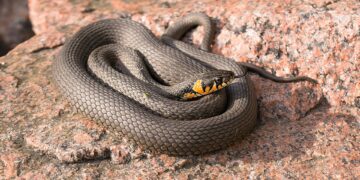
Non-venomous and harmless Croatian species you’re likely to encounter include the four-lined snake (the largest snake in Croatia, up to 2 metres, completely harmless), the Aesculapian snake, and the dice snake. None of these are dangerous animals. If in doubt about whether a snake is venomous, treat it as if it is — keep your distance and move away calmly.
Where Venomous Snakes Are Found: Dalmatia, the Adriatic, and Beyond
The nose-horned viper is most common in Dalmatia — the rocky, sun-baked coastal strip and its hinterland that stretches from the Kvarner Gulf south to Dubrovnik. It is also found on larger Adriatic islands and throughout the karst limestone regions of the Dinaric Alps. In Gorski Kotar, the densely forested mountain region of central Croatia, the common European viper is the predominant venomous species.
Vipers particularly favour: dry, rocky hillsides with sparse vegetation; old stone walls and ruins; scrubby slopes where forest meets meadow; areas near water during dry periods; and south-facing slopes with good sun exposure. They are most active in spring and autumn — emerging from hibernation in March or April, most active through May and June, then again in September. Vipera ammodytes ammodytes is mostly active at night; daytime encounters typically involve a snake basking in early morning or late afternoon sun.
Snake activity peaks in the warm months from April through October, with the highest number of bite incidents historically occurring in May. During the midday heat of summer, snakes typically retreat to shade and are less likely to be encountered on open trails.
How to Stay Safe: Preventing Snake Bites on Croatian Trails
The Croatian Institute of Public Health’s advice is direct: if you see a snake, leave it alone. The vast majority of snakebite cases in Croatia involve people who tried to catch, handle, or kill the snake. Simply observing from a safe distance and moving around eliminates most of the risk.
Practical steps to avoid getting bitten while hiking in Croatia:
• Wear long trousers and sturdy ankle-covering hiking boots — not sandals or trainers. Most bites occur on the lower legs and feet. Wear long enough coverage to protect the ankle and lower calf.
• Watch where you step, especially near rocks, stone walls, logs, and tall grass. Step onto rocks and logs rather than over them, so you can see what’s on the other side.
• Never reach into crevices, under rocks, or into vegetation you can’t see into clearly.
• Use trekking poles to tap ahead in overgrown sections of trail.
• Keep children and dogs close — their curiosity around unfamiliar animals is the most common cause of non-adult bites.
• Be more cautious in Dalmatia and rocky coastal areas, which are prime poskok habitat.
Snakes detect ground vibrations. Normal walking and conversation are usually sufficient to alert snakes to your presence, giving them time to move away before you arrive.
If You’ve Been Bitten by a Snake: First Aid and Medical Care
If you’ve been bitten by a snake in Croatia, call 112 immediately and go to the nearest medical facility. Do not wait for symptoms to develop.
In the case of a bite, the Croatian Institute of Public Health recommends the following immediate steps:
• Stay as calm and still as possible — elevated heart rate speeds venom circulation through the body.
• Remove rings, watches, and any tight clothing near the bite site before swelling begins.
• Keep the affected limb at or slightly below heart level — do not elevate it.
• Note the time of the bite and photograph the snake from a safe distance if possible, to help trained healthcare professionals identify the species.
• Call 112 (Croatia’s emergency number) immediately and explain you’ve been bitten by a snake.
• Get to the nearest medical facility or hospital immediately — do not wait.
• If symptoms of venom poisoning appear — severe pain and swelling, rapid spreading bruising, nausea, dizziness, difficulty breathing — seek help immediately and tell medical staff you need antiserum.
What NOT to do if you’ve been bitten:
• Do not apply a tourniquet or tight bandage above the bite.
• Do not cut the wound or attempt to suck out venom.
• Do not apply ice, heat, or any traditional remedy.
• Do not give alcohol or medication.
• Do not allow the person to walk or exert themselves more than necessary.
• Do not carry antiserum yourself — it requires refrigeration and must be administered by trained healthcare professionals.
Croatian hospitals in Zagreb, Split, Rijeka, and Dubrovnik all stock antiserum (antivenom) and have experience treating venomous snake bites. Regional medical centres throughout Dalmatia and the Adriatic coastal areas can provide initial treatment. Emergency evacuation from major Croatian hiking trails is generally fast, with good mobile coverage on popular routes. Emergency number: 112.
Frequently Asked Questions About Dangerous Animals and Snakes in Croatia
Are Croatian snakes dangerous to hikers?
Three of Croatia’s 15 species of snakes are venomous: the nose-horned viper (poskok/Vipera ammodytes), the common European viper (riđovka/Vipera berus), and the meadow viper. The remaining species are non-venomous and harmless. Snakebite fatalities are extremely rare — just three deaths in twenty years according to the Croatian Institute of Public Health. Hikers who wear appropriate footwear and leave snakes alone face very low risk.
What is the poskok and where is it found in Croatia?
Poskok is the Croatian name for the nose-horned viper (Vipera ammodytes ammodytes) — the most dangerous of the European vipers and the most significant venomous snake species in Croatia. It is most prevalent in Dalmatia and the Adriatic coastal regions, where it inhabits dry, rocky terrain. It is identifiable by the small horn on the tip of its snout, its triangular head, and the dark zigzag pattern along its back. It is mostly active at night.
What should I do if I’ve been bitten by a snake in Croatia?
Stay calm, keep still, remove tight clothing near the bite, keep the limb below heart level, and call 112 immediately. Get to the nearest medical facility or hospital without delay. Do not attempt to cut, suck, or tourniquet the bite. Croatian hospitals stock antiserum for venomous snake bites. In the case of a bite, speed of medical treatment is the most important factor in outcome.
How do I know if a snake is venomous in Croatia?
Venomous Croatian snakes — all members of family Viperidae — have a triangular head clearly distinct from the neck, vertical cat-like pupils, a thick body, and a zigzag dorsal pattern. The nose-horned viper additionally has a small horn on its snout. Non-venomous species have a narrow head blending into the body, round pupils, and a slender build. If in doubt, assume the snake could be venomous and keep your distance.
Is it safe to hike in Dalmatia given the vipers?
Yes. Thousands of hikers walk the trails of Dalmatia every year without incident. The poskok is shy and typically retreats when it detects human presence. Wear ankle-covering boots, wear long trousers, watch where you step, and never attempt to handle a snake. These precautions make a dangerous encounter extremely unlikely.
Stay Safe and Enjoy Croatia’s Trails
Understanding venomous snakes in Croatia is simply part of hiking responsibly in a biodiverse country. The nose-horned viper is a genuinely remarkable animal — the most venomous viper in Europe, and a creature that has inhabited these rocky Dalmatian hillsides for millennia. It is also, for any hiker who respects it and gives it space, essentially no threat at all.
Wear the right boots, stay on the trail, and don’t touch snakes. Croatia’s mountains, forests, and coastlines will reward you with some of the most beautiful hiking in Europe — and the wildlife, vipers included, is part of what makes it extraordinary.
Emergency number in Croatia: 112 (medical, fire, police). Croatian Mountain Rescue Service (HGSS): available 24 hours via 112.