
















Croatia: Currency, Euro, Payment Methods & Exchange Tips — A Complete Guide
You’ve landed. You’ve got a bag, a rough plan, and at some point in the next hour you’re going to need to buy something — a coffee, a water taxi ticket, parking. This is the moment most people realise they haven’t thought about money in Croatia at all.
Here’s what you actually need to know: Croatia adopted the euro on 1 January 2023, so the currency and payment landscape is straightforward for most European visitors and reasonably simple for everyone else. Cards work widely, ATMs are plentiful in cities and tourist areas, and mobile payments are increasingly popular in Croatia. Cash still matters in smaller towns and markets. This travel guide covers all of it.
Currency in Croatia: The Euro Since 2023
The official currency in Croatia is the euro (€). Croatia joined the eurozone on 1 January 2023, replacing the Croatian kuna (HRK), which had been the national currency for over three decades. If you have any leftover kuna from a previous visit, the Croatian National Bank continues to exchange them, but they are no longer accepted anywhere as payment.
For visitors arriving from other European countries already using the euro — Germany, France, Italy, Spain and most of the rest of the EU — there’s nothing to exchange. Your euros work directly. For visitors from the UK, US, Australia, or anywhere outside the eurozone, you’ll need to exchange your home currency before or after arrival.
|
ℹ Note Croatia adopted the euro as its national currency on 1 January 2023. The old Croatian kuna is no longer in circulation. Any kuna can still be exchanged at the Croatian National Bank. |
ATMs in Croatia: Where to Find Them and What to Expect
ATMs are easy to find across Croatia. In Zagreb, Split, Dubrovnik, and other major cities and tourist areas, you’ll see them at banks, shopping centres, and near the main squares. In smaller coastal towns and on islands, ATMs exist but there may only be one or two per settlement — and they do run out of cash in peak season.
Most ATMs accept Visa, Mastercard, Maestro, and Cirrus cards. When withdrawing cash, always choose to be charged in euros rather than your home currency — this avoids the inflated dynamic currency conversion rate that the ATM operator applies.
Withdrawing cash from an ATM abroad typically incurs a fee from your home bank — often a flat charge plus a percentage per transaction. To minimise this, withdraw larger amounts less frequently rather than small amounts multiple times. A single withdrawal of €100–200 is almost always cheaper than four withdrawals of €30.
|
💡 Tip Always decline the ATM’s offer to convert to your home currency. Choose euros every time. The bank’s rate will be better than the ATM operator’s conversion rate. |
Cash or Card: What Works Where in Croatia
The honest answer is: both. Card acceptance in Croatia is strong in cities and established tourist destinations. In Zagreb and Split you can go a full day paying by card for everything from coffee to accommodation. Dubrovnik is similarly card-friendly. Visa and Mastercard are the most widely accepted networks. American Express has limited acceptance — worth checking before you rely on it.
That said, there are still situations where you need cash. Markets, smaller family restaurants, some beach bars, and local taxi drivers often prefer cash payments. Rural villages and smaller towns are less reliably covered. A small amount of cash — €30 to €50 — is worth keeping in your wallet throughout your trip.
Debit cards work well at most major retailers, supermarkets, and hotels. Credit and debit cards from UK and non-EU banks generally work without issues at standard payment terminals. If your foreign card is declined somewhere, it’s usually a terminal issue rather than a blanket policy — try a different payment method or try again.
|
⚠ Warning Some smaller businesses, including local markets and beach kiosks, are cash only. Including cash in your travel setup is advisable even if you plan to pay by card most of the time. |
Mobile Payments in Croatia: Apple Pay, Google Pay, and Contactless
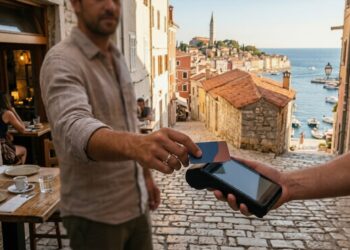
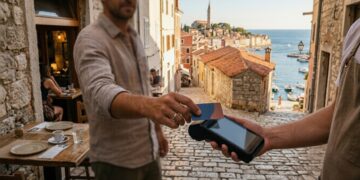
Mobile payments are increasingly part of everyday life in Croatia. Apple Pay and Google Pay are both accepted at most modern card terminals — the same terminals that take contactless payments will generally support both. In Zagreb and the major coastal cities, you can pay for groceries, restaurants, and transport without taking your wallet out.
Contactless payments via card are standard across hotels, larger restaurants, and supermarkets. Cards and mobile payment methods work at the same terminals, so if your phone supports it, you’re covered wherever cards are accepted. The main exception, as with cards, is smaller businesses and markets — these tend to prefer or require cash.
Croatia’s younger hospitality sector — newer hotels, trendy bars, fast-casual restaurants — has adopted mobile and contactless infrastructure quickly. Older establishments, particularly in rural areas, are less likely to have updated their terminals.
Currency Exchange: Where and How to Exchange Money in Croatia
If you need to exchange money in Croatia, you have several options. Banks offer reliable rates with transparent fees. Exchange offices (mjenjačnice) are common in tourist areas and at airports — they’re convenient but rates vary significantly. Always check the rate and fee before you commit.
The airport exchange desk is the most convenient but rarely the best value. The exchange rate at airport bureaux de change tends to be less favourable than in town. If you can, carry enough euros from home or withdraw from an ATM on arrival rather than exchanging at the airport.
You generally don’t need to exchange for euros if you’re arriving from the eurozone — your euros already work. If you’re exchanging from sterling, dollars, or another currency, comparing the exchange rate at a bank versus an independent exchange office is worth a few minutes of your time.
|
💡 Tip Avoid exchanging money at the airport if possible. ATM withdrawals in euros will almost always give you a better effective rate than bureau de change counters, even after your bank’s withdrawal fee. |
Tipping in Croatia: What’s Expected
Tipping is customary in Croatia but not obligatory. In restaurants, rounding up the bill or leaving 10–15% for good service is standard. Some places include a service charge — check the bill before tipping. In bars, rounding up for drinks is appreciated. Your taxi driver won’t expect a tip but won’t refuse one.
When paying by card, you can sometimes add a tip via the terminal. In cash-first settings, leave a tip in cash on the table. In high-season tourist areas — particularly Dubrovnik and the Dalmatian coast — tipping culture is well established.
Planning a Trip to Croatia: Quick Payment Summary
To pull it all together before you travel:
• The official currency is the euro. No kuna needed.
• Cards (Visa, Mastercard) are widely accepted in cities and tourist areas.
• ATMs are available everywhere — withdraw larger amounts to reduce transaction fees.
• Carry a small amount of cash for markets, local taxis, and smaller towns.
• Apple Pay and Google Pay work at most modern terminals.
• Avoid dynamic currency conversion at ATMs — always choose euros.
• Exchange money at a bank or ATM rather than at the airport for better rates.
• Booking accommodation in advance usually requires card payment.
|
ℹ Note If you’re visiting Croatia soon, the most practical setup is a contactless card with low foreign transaction fees, a small amount of euro cash, and Apple Pay or Google Pay as a backup. That combination covers almost every situation you’ll encounter. |
Croatia’s currency and payment situation is genuinely one of the easier things to manage as a tourist. The euro makes it familiar for most European visitors, card infrastructure is solid in the places most visitors spend their time, and mobile payments are growing fast. The main thing to remember: carry a little cash, decline the ATM’s conversion offer, and you’ll be fine.