


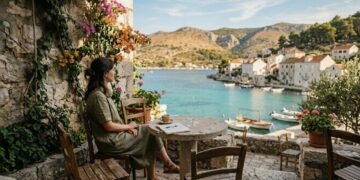


Fjaka: Embrace the Croatian Art of Doing Nothing in Croatia
You’ve been moving for days. The ferry from the mainland, another island-hopping leg to Hvar, a taxi uphill to a terrace café — and now, somehow, you’ve stopped. The afternoon sun is warm on your arms. You sip something cold and local. The Adriatic Sea shimmers somewhere below. And you have absolutely nowhere to be.
This is fjaka (pronounced fyah-kah). And you’re already in it.
What Is Fjaka? Croatia’s Croatian Secret to Happiness
There’s no direct translation. Linguist Jakša Fiamengo described it as something close to a “faint unconsciousness” — not sleep, not thought, not quite here. The term for a relaxed state of body and mind that Dalmatians have cultivated across centuries, fjaka sits somewhere between a siesta and meditation. It’s a concept of fjaka that refuses definition — which may be exactly why it works.
Croatians who grew up on the coast understand this state of mind intuitively. It’s an integral part of life in Dalmatia, woven into the pace of the afternoon, the shade of a fig tree, the rhythm of the Adriatic. You don’t schedule fjaka. You let it find you.
Writer David Farley, who spent time exploring Croatia’s coastal culture, noted that what made Dalmatian towns feel different wasn’t the architecture or the food — it was the way time moved. Or didn’t move. That quality has a name. Call it the Mediterranean way, the Dalmatian pace, or simply the Croatian secret to happiness — the concept is the same: slow down, or the afternoon will pass without you ever arriving in it.
|
📖 A note on pronunciation Fjaka is pronounced “fyah-kah” — two syllables, soft and unhurried. Which is, in itself, the point. |
Fjaka Isn’t Laziness — It’s a Croatian Way of Life
This is where tourists sometimes get it wrong. Fjaka isn’t idleness. It’s not laziness misread as a cultural quirk. It’s not lost productivity. And finding the right way to understand it matters — because if you approach it as something to be scheduled or optimised, you’ve already missed the point.
In a warm climate where the midday summer heat makes anything resembling effort genuinely counterproductive, fjaka is the intelligent response. The body slows down, the mind follows. You’re not avoiding life — you’re experiencing it at the pace it was meant to move.
Croatian coastal culture has always understood something that northern Europe is still arguing about: rest is not the opposite of wellbeing. It’s the foundation of it. Sitting still in a shady spot by the bay, watching nothing in particular, is not a waste of an afternoon. It is the afternoon. There’s no hurry. There’s no need to fill the silence. That, for most tourists, is the hardest part.
Which Croatia Destination Is Best for Embracing Fjaka?
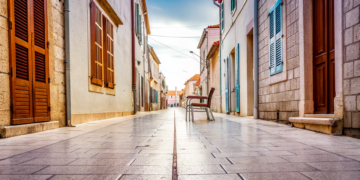
Some destinations make it easier than others. In Croatia, the pace of life in coastal towns is built around the afternoon — the cafés empty out, the shutters drop, and the only people still moving are the ones who arrived last week and haven’t learned yet.
Vis
The most remote of Croatia’s inhabited islands. There are no cruise ships docking here, and the island-hopping crowd tends to laze on the rocks and lounge in the shade rather than race between sights. Wander the back lanes of Komiža, find a shaded courtyard, order something local, and wait. Fjaka will arrive before your second drink.
Hvar
Hvar has two speeds: the fast tourist strip and everything behind it. Walk ten minutes inland from the waterfront and you’ll find a café where the same three locals have been sitting since 11am. They’re not waiting for anyone. They’re not going anywhere. Take a seat. Order a coffee. You’re now doing it correctly.
Dubrovnik’s quieter edges
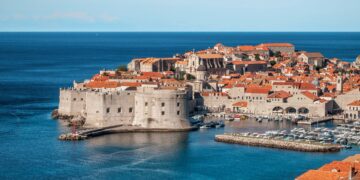
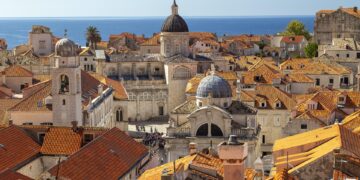
Everyone hurries in Dubrovnik — to the walls, to the next viewpoint, to the cable car queue. But walk beyond the old town and you’ll find a cliff path above the water, a small beach below, a flat rock perfect for a nap when the sun angles right. The city looks completely different from horizontal.
Zagreb’s hidden courtyards
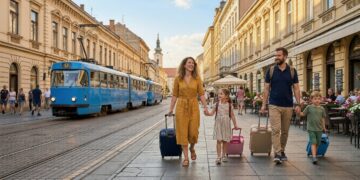
Fjaka isn’t only coastal. Zagreb has its own version — the quiet courtyard behind a passage on Gornji Grad, a café table in Tkalčićeva where no one minds if you don’t order a second coffee or spend two hours not doing very much at all.
|
💡 Solo traveller tip Fjaka is easiest alone. When there’s no one to agree with or keep up with, you stop filling time. Order a coffee. Sit near the water. Let the afternoon happen. |
How to Feel Fjaka: A Practical (Non-Productive) Guide
If you’re the kind of traveller who travels with a list, this section is for you. Set the list aside for the next four hours and try the following:
Find shade. Not a sun lounger with a parasol — actual shade, the kind under an old stone wall or a gnarled olive tree. This means arriving early or walking past the main strip until the crowd thins. The warmth of the sun should be ambient, not direct.
Order something unhurried at a sunny cafe and lounge in your chair like you’ve paid rent on it. A local wine, a craft beer, a coffee you won’t finish quickly. Cafés in Dalmatia do not rush you. Taking time is the expected behaviour, not the exception. Relaxation here isn’t a reward for finishing your to-do list — it’s the point of being here at all.
Put the phone in your bag. Not on the table. In the bag. The present moment doesn’t photograph well anyway, and the attempt to capture it is precisely what dissolves it. Resist the urge to narrate internally too — the running commentary of what you’ll do next, what you’ll tell people when you’re home. Fjaka asks you to suspend all of that.
Notice when it happens. It will feel like something unlocking. The sense of time shifts — not because time actually slows, but because you’ve stopped fighting it. That’s fjaka. That’s the secret to happiness — at least one very honest version of it.
Ferry, Beach and Island-Hopping: How to Feel Fjaka in Summer
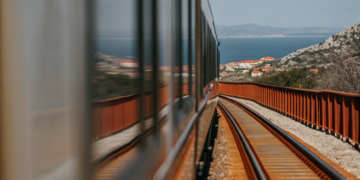
The ferry crossing is underrated as a fjaka opportunity. Most travellers treat it as dead time — something to endure before arriving somewhere. But a two-hour crossing from Split to Vis, with a beer in your hand and nothing but open water ahead, is exactly the kind of unstructured time that fjaka needs. You can’t rush a ferry. You can only be on it.
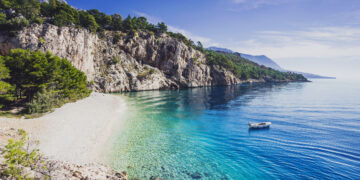
The beach, similarly, operates on its own clock. A morning swim, then a slow drift back to a towel on warm stone, then maybe a nap, then a wander up to wherever the shade is better at 2pm — this is not laziness. This is the structure of a Dalmatian afternoon, built over centuries by people who understood that the sun dictates the schedule, not the other way around.
Island-hopping has become a popular way to see Croatia. Done right, it’s wonderful. Done wrong — one island every 36 hours, always moving, always optimising — it’s the opposite of fjaka. The travellers who come back happiest are the ones who spent four nights on Vis or three slow days on Brač, rather than touching seven islands in a week. Stay long enough to feel the place settle around you. That’s when fjaka arrives.
|
🌊 When does fjaka work best? Midday to mid-afternoon, during peak summer heat. Between 1pm and 4pm, the coast essentially pauses. Don’t fight it — join it. This is when Dalmatians have always practised fjaka, and the timing is not a coincidence. |
Fjaka and Mindful Travel: Why It Matters Now
The word ‘mindful’ gets overused. It appears in wellness retreats and app descriptions and the kind of travel writing that forgets people are on holiday, not in therapy. But fjaka is mindful in the original sense: it puts you squarely in your body and mind, in one place, at one moment, without an agenda.
You can’t practise fjaka while checking your phone. You can’t embody it while making a mental list. The concept of fjaka is structurally incompatible with distraction — and that, in a world built around distraction, is quietly radical. It’s not a technique. It’s a surrender. And at the heart of that surrender — #fjaka, as Dalmatians sometimes sign off on the sentiment — is a kind of contentment that most wellness products are trying very hard to sell you.
Younger travellers especially — the ones who document everything, who measure experiences in content value — often discover fjaka by accident. They sit down to rest on a sun-warmed cliff above the sea, they end up staying two hours, and they describe it afterwards as the best part of the trip. Of course they do.
Croatia’s everyday life has contained this for centuries. Dalmatians didn’t invent it as a wellness practice or a tourism concept. It emerged from the warm climate, the coastline, the slow pace that the Adriatic Sea demands. Tourists, it turns out, just needed someone to give it a name.
Hrvatska has been practising fjaka long before it became a concept worth Googling. The next time someone asks what you did in Croatia, tell them you learned to do nothing. And that it was the best thing you did all summer.